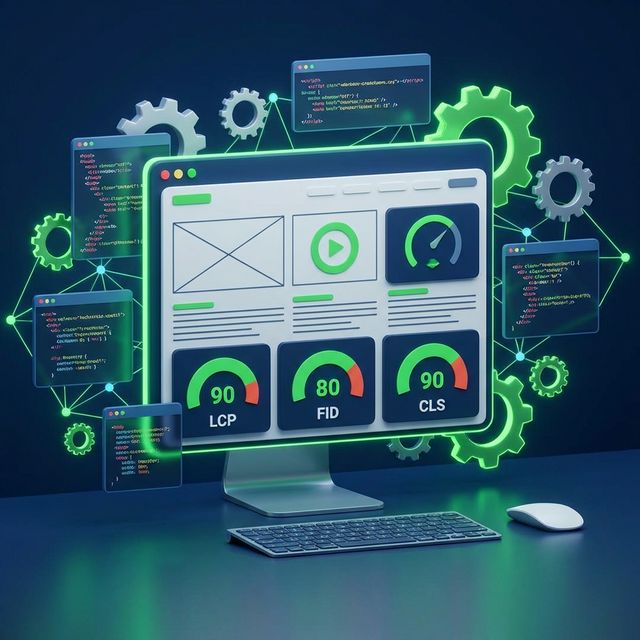
Technical SEO has evolved from "fixing broken links" to "optimizing for machine understanding." In 2026, your website needs to speak two languages fluently: Human (for UX) and JSON (for AI agents).
We've audited over 500 enterprise sites this year. The sites that survived the March 2025 Core Update all had one thing in common: Technical Excellence. They didn't just load fast; they were structured databases disguised as websites.
The 2026 Priority Shift
Old Goal: Improve PageSpeed Insights score.
New Goal: Optimize for Interaction to Next Paint (INP) and
AI Crawler Budget.
Phase 1: Core Web Vitals & UX (The "Human" Layer)
Google's Core Web Vitals are no longer just tie-breakers; they are gatekeepers.
1. Master INP (Interaction to Next Paint)
FID (First Input Delay) is dead. INP measures the responsiveness of every interaction, not just the first click.
- Benchmark: Aim for < 200ms.
- The Fix: Break up long tasks in your main thread. Use `requestIdleCallback` for non-essential JavaScript execution.
- Tool: Use the Chrome User Experience Report (CrUX) dashboard, not just Lighthouse lab data.
2. Stabilize Visuals (CLS)
Cumulative Layout Shift scores must be under 0.1. In 2026, dynamic ads and injected AI content are the biggest culprits.
- The Fix: Reserve space for everything, including dynamic ad slots and consent banners.
Phase 2: Optimizing for AI Crawlers (The "Machine" Layer)
Your site is now visited more often by AI agents (GPTBot, ClaudeBot, Google-Extended) than by humans. If you block them, you disappear from the answers.
3. Robots.txt Strategy
Do not block AI bots unless you have a paywall.
Allow: /
User-agent: Google-Extended
Allow: /
Why? If ChatGPT or Gemini can't read your content, they can't cite you as a source in their answers.
4. Consolidate Crawl Budget
AI crawlers are hungry but expensive to run. They prioritize sites with high "Information Density."
- Pruning: Delete or noindex pages with < 300 words of unique content.
- Redirect Chains: Fix 100% of internal redirect chains. They confuse AI agents trying to map your site structure.
Phase 3: Structured Data (Speaking "JSON")
Schema markup is how you hand-feed the answers to search engines.
5. Nest Your Schemas
Don't just throw `Article` and `BreadcrumbList` on a page separately. Nest them. Use the `@graph` method to show the relationship between the `Article`, the `Author`, and the `Organization`.
6. Entity SEO
Use `SameAs` properties to link your content to recognized entities in the Knowledge Graph (e.g., Wikipedia pages, Crunchbase profiles). This builds topical authority.
Phase 4: Security & Infrastructure
7. HSTS & Security Headers
HTTPS is baseline. In 2026, you need HSTS (HTTP Strict Transport Security) preloading to prevent man-in-the-middle attacks and improve load times by eliminating the HTTP-to-HTTPS redirect.
8. Edge SEO
Move your redirects and header modifications to the Edge (Cloudflare Workers or AWS Lambda@Edge). Handling these at the server level adds latency. Handling them at the edge is instant.
Is Your Site Ready for the AI Era?
Technical SEO is complex, but the ROI is undeniable. Get a comprehensive 100-point technical audit from our engineering team.
Get Your Technical Audit